1. ATP and Energy
Life is a control process against thermodynamic law, the arrow of entropy. “We are riding waves of increasing entropy, we are surfers on the arrow of time.” The primary driver of these moving machine gears begins at proton pumps, the powerhouses of ATP synthetase production. Every day, survival has a cost, as the ATP molecules used almost match the weight equivalent of your body.
The price of getting this ATP synthesized requires exploration of the environment in search of food sources. This defines the selected niche and the behavioral activities of the individual organism.
2. DNA Helix
Chromosomal codes are information, defining the policy of an organism’s future life behaviors. The basic gene units, the triple nucleotide sequence in a codon, are not the only determinants of any future developmental trait. There are many overarching supervisors in the process of transcription regulation, such as promoters, operators, enhancers, activators, inhibitors, and silencers. Not to mention the homeotic clusters, the 39 HOX genes, which are master genetic coding programs.
The full diversity of shapes, sizes, and appearances in organisms across the evolutionary tree of life is built through manipulation of two controls: genetic codes and the policy of body-segment repetitions. It is like rotating knobs to create diversity, controls that change the pace of (a) the rate of growth of body segments, and (b) the rate of shape change, controlled through genetic programs such as the HOX genes.
Epigenetic changes have another story, changes made through lifetime experiences. So, we are all products of nature and nurture.
3. Evolutionary Changes in Hominids
Not only is a well-built, efficient brain mandatory, but it also has to learn through experience, whether by classical Pavlovian passive learning or by operant learning through active participation. Rewards lead to desired results in learning. All of these computations are supported by efficient circuits and connectomes. The underlying network and connectivity provide tools and spandrels in evolution.
Emotions become constructed into language, symbolic as monologues in the mind, or dialogic as communication. Memes and lifetime experience break open the limitations of mortal lifetimes. Social skills, altruism, knowledge, and interactions create safety and progress, with an exponential rise in quality of life.
4. Cell Membrane Receptors
These are wonder-information sensors, cradling life inside fortified defenses. They exchange energy, information, and intelligence through coded sensory inputs, with all ports open only through these gates. The innovation generated by evolution to create the neuron was the most complex use of receptors in the gating of information.
The specialized requirement for unidirectional flow of information in neural circuits made use of Boolean AND, OR, and NOR logics. Receptors grew in even greater complexity, and specific membrane receptors became localized in zones of neuron synapses to create the magic of affect, perception, and motor responses. In a way, it is only the receptors sitting at the limits of cell membranes, nuclear borders, intracellular organelles, and synapses that decide the functional codes of life.
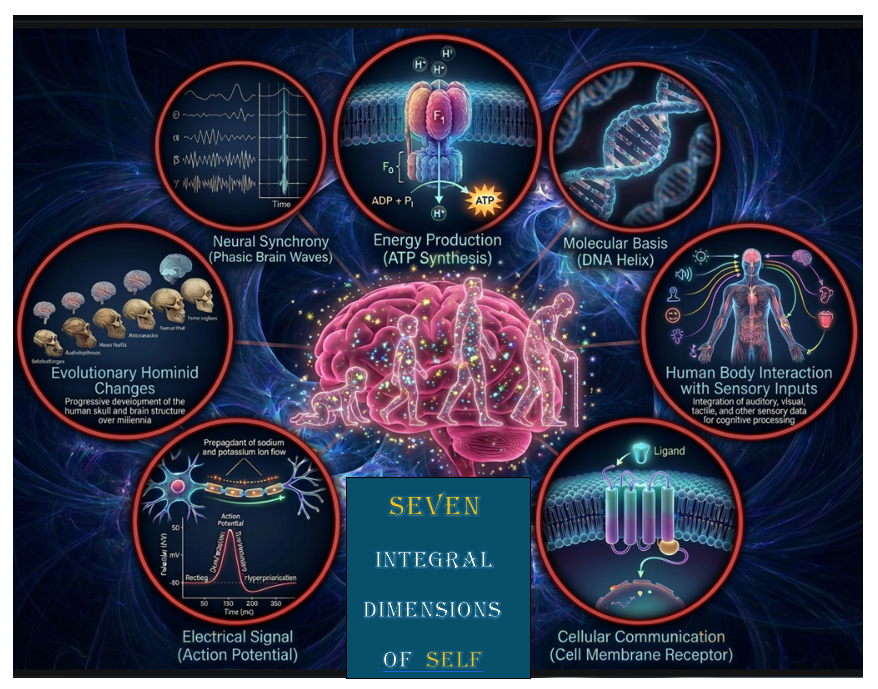
5. Action Potential
The inherent electrical properties of the neuron form the basis that decides the direction of flow, the command-chain structure, through cellular mechanics so fundamental in nature. Action potential is explained by voltage- and time-dependent changes in the permeability of cell membranes.
The coupling of two cycles, fast sodium ionic positive drives and slow potassium ionic flows that limit and brake the open floodgates of exchange, creates the action-potential spike traveling unidirectionally into axons. It touches and excites neighboring neuron dendrites at synapses with spike-coded information, scripting the whole “grand story of I, Me, and Mine.”
6. Neural Synchrony (Phasic Coherence)
This may be similar to resonance, like a biological version of modern Bluetooth or Wi-Fi in principle. Although our organic brain circuits have efficient electrical, ionic conduction, the magnetic fields generated are far too feeble to compete with non-organic versions. Also, total energy consumption is limited, so the brain cannot cause any “spooky action at a distance.”
But nature has wonderful ways to imitate similar results within its organic, living medium of local field potentials. Here, powerful small-world neuronal circuits of interneurons and other neurons are able to coordinate, with prime pyramidal neuron spikes traveling through fast-conducting axons to distant targets. Neurons can display a broad range of behaviors in the rate and rhythm of spike generation based on surrounding local fields. That is what makes phasic coherence possible and produces coordinated and unified resultant motor outputs. The same would apply in higher abstract, symbolic, and intelligent outputs.
7. Human Body Interactions
This is the final frontier in our human explorations, interactions, predictions, and affordance selections. The basic drive is reward and punishment, with homeostasis and valence factored in. Sensory inputs are analyzed, and finally intelligent choices are made to execute the required motor and affective outputs. The optimum choice is selected and vetoed among all affordances, and it may not necessarily be the best, depending on the “principle of delayed gratification.”
The newborn brain is not a “tabula rasa.” It already carries inherent imprinted programming. From the moment of birth, it follows a trajectory of binary decisions made at every moment, owning prediction errors, learning from them, and using the powerful gifts of intelligence to reach the wisdom of a mature personality, an enlightened self.